
10 Best AGV Technology Solutions for Global Buyers
Global warehouses are moving beyond fixed conveyor lines. Agv Technology now supports pallet transport, kitting, replenishment, and flexible production flows. In a busy facility, one vehicle may carry a 1,000-kilogram load between receiving and storage. Another may deliver components beside an assembly station.
The market is expanding, but adoption requires evidence. The International Federation of Robotics reported 541,302 industrial robots installed worldwide in 2023, showing strong investment in automated operations. Its World Robotics 2024 report also recorded more than 4.2 million industrial robots operating globally. These figures do not measure AGVs directly. However, they reveal a mature automation ecosystem for buyers to evaluate. The MHI 2024 Annual Industry Report likewise identifies robotics, data visibility, and workforce development as major supply-chain priorities.
Performance matters more than impressive demonstrations. “I can’t define a robot, but I know one when I see one,” robotics pioneer Joseph Engelberger famously said. His observation remains useful. Buyers should inspect navigation accuracy, battery charging, payload stability, fleet software, safety sensors, and service response.
Small details decide large outcomes.
This guide reviews 10 Best AGV Technology Solutions for Global Buyers through that practical lens. It considers deployment environments, integration effort, total ownership cost, and supplier credibility. Regional regulations and facility layouts can change the result. A solution that succeeds in a flat European warehouse may struggle on uneven floors in a high-humidity plant. No ranking can remove that uncertainty. Careful testing still matters.
AGV Technology Basics and Core Components
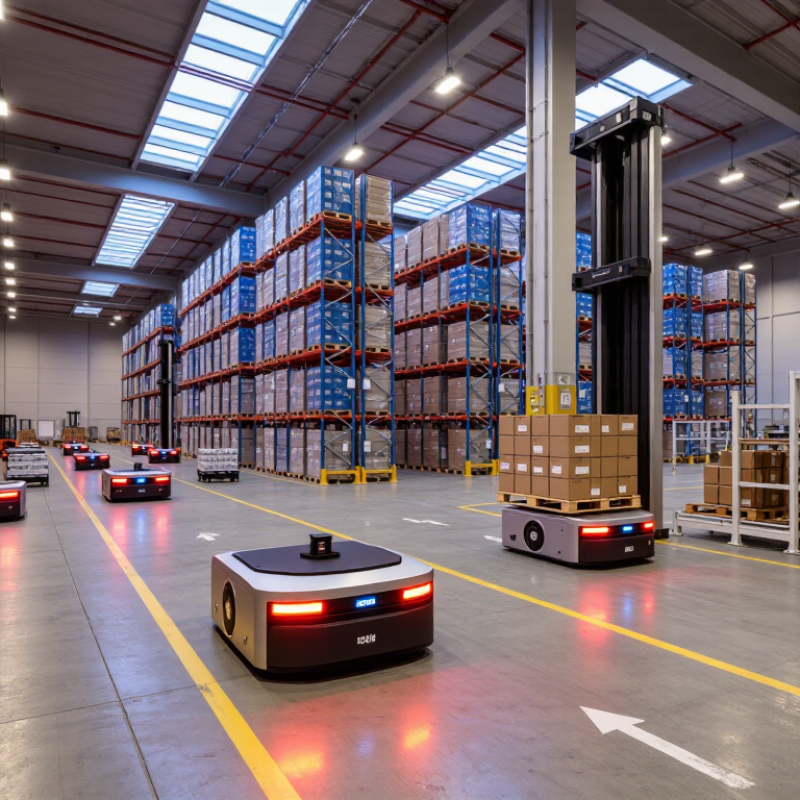
AGV technology starts with a clear division of labor. The vehicle carries loads, while software controls routes, tasks, and traffic. Core components include the chassis, drive motors, battery, sensors, controller, and safety system. Laser scanners support navigation and obstacle detection. Cameras can improve identification in complex areas. Fleet software assigns missions and records performance data. According to Interact Analysis, the global mobile robotics market is expected to grow strongly through 2027, driven by warehouses and manufacturing sites. Growth alone does not guarantee a suitable system.
Practical evaluation should begin with floor conditions, payload weight, aisle width, and charging patterns. A 1,000-kilogram vehicle needs different motors and braking logic than a small tote carrier. Battery chemistry affects uptime, heat control, and maintenance frequency. Wireless communication also matters. A weak signal can create delays near metal racks or cold-storage doors. The International Federation of Robotics reported 541,302 industrial robot installations worldwide in 2023. AGVs are not included in every robotics statistic, but the figure shows rising automation pressure. Human review remains necessary. No sensor works perfectly.
Tips: Test one route during a busy shift. Measure waiting time, stopping distance, battery use, and manual interventions. Ask technicians to inspect sensor dust and wheel wear weekly. Leave space for software updates and changing workflows. A pilot may reveal unexpected problems, which is useful.
AGV Technology Basics: Typical Battery Voltage by Vehicle Class
Battery voltage is a core AGV design parameter that affects motor performance, charging architecture, energy efficiency, and payload capability. The values below represent common nominal voltage levels used across industrial AGV platforms and are not market-share figures.
In general, higher-payload AGVs use higher-voltage electrical systems to support stronger traction motors and reduce current demand during operation.
How to Evaluate AGV Solutions for Different Industrial Needs
10 Best AGV Technology Solutions for Global Buyers
Choosing an AGV begins with the workflow, not the equipment catalog. A 600-kilogram pallet route needs different performance from a small-bin delivery task. Measure load weight, aisle width, floor quality, travel distance, and daily cycles. A vehicle that performs well in a showroom may struggle beside a cold-storage door or uneven concrete.
Navigation technology deserves close testing. Laser-based systems can adapt to changing layouts, while magnetic guidance may suit fixed routes and simpler operations. Check stopping accuracy near racks, people, and loading stations. Safety sensors must support local workplace requirements, emergency stops, and controlled speed zones. Ask for test data, not only promised travel rates. Real factories contain dust, glare, noise, and unexpected obstacles.
Integration often determines the actual return. The AGV should exchange clear signals with warehouse software, elevators, doors, and charging systems. Review battery runtime, charging time, maintenance access, spare-parts availability, and remote diagnostics. A short pilot with real pallets can reveal hidden delays, especially during shift changes. We have seen projects focus heavily on navigation while underestimating operator training and traffic rules. That is an easy mistake. Buyers should also calculate total ownership costs over several years, including software updates and floor preparation. A solution may look efficient, yet require costly changes to the building. Test the complete process before approving a global rollout.
10 Best AGV Technology Solutions for Global Buyers - How to Evaluate AGV Solutions for Different Industrial Needs
| Solution Type | Primary Industrial Need | Typical Navigation | Typical Payload Range | Typical Travel Speed* | Load Handling | Best-Fit Applications | Key Evaluation Criteria | Main Limitation |
|---|---|---|---|---|---|---|---|---|
| 1. Unit-Load Transport AGV | Moving standardized loads between production, storage, and shipping areas | Laser, natural-feature, QR-code, or hybrid navigation | 500–2,000 kg | 0.8–1.5 m/s | Top-mounted conveyor, rollers, or deck | Automotive components, electronics, appliances, and general manufacturing | Load dimensions, transfer height, docking accuracy, route density, and interface compatibility | Requires consistent load presentation and clearly defined transfer points |
| 2. Tugger Train AGV | High-volume line-side replenishment using multiple carts | Magnetic tape, laser, natural-feature, or mapped navigation | 1,000–5,000 kg total train capacity | 0.6–1.2 m/s | Towed carts, stillages, or roll cages | Automotive assembly, industrial equipment, and large-scale production | Turning radius, train length, aisle width, coupling method, and pedestrian interaction | Needs wide, predictable routes and sufficient maneuvering space |
| 3. Automated Guided Forklift | Automating pallet transport, staging, and put-away operations | Laser, reflector, QR-code, or natural-feature navigation | 1,000–3,000 kg | 0.8–1.5 m/s | Fork pockets, floor-level pallets, and rack locations | Warehouses, distribution centers, cold-chain facilities, and factories | Pallet quality, rack tolerance, floor condition, lift height, and safety zoning | Damaged pallets, uneven floors, or variable rack conditions can reduce reliability |
| 4. Pallet Stacker AGV | Automated pallet stacking and retrieval at moderate storage heights | Laser, QR-code, or natural-feature navigation | 500–1,500 kg | 0.6–1.2 m/s | Forks with lift mast, usually for floor or low-level storage | Small warehouses, manufacturing supermarkets, and buffer storage | Required lift height, pallet stability, aisle width, and floor flatness | Less suitable for very high-bay storage or highly irregular pallet loads |
| 5. Conveyor-Top AGV | Flexible point-to-point movement with automated load transfer | Laser, camera, QR-code, or hybrid navigation | 300–1,500 kg | 0.8–1.5 m/s | Roller, belt, chain, or lift-and-transfer conveyor | Packaging, sorting, assembly, and goods-to-line delivery | Conveyor height, transfer timing, load center, PLC communication, and throughput | Requires precise mechanical and software integration at every handoff |
| 6. Low-Profile Cart Carrier | Moving wheeled carts or racks under space-constrained conditions | Laser, visual, QR-code, or natural-feature navigation | 300–1,000 kg | 0.6–1.2 m/s | Under-riding, towing, or lifting a dedicated cart | E-commerce fulfillment, apparel, electronics, and kitting operations | Vehicle clearance, cart geometry, load stability, fleet traffic, and charging strategy | Performance depends on standardized carts and adequate clearance beneath them |
| 7. Cleanroom AGV | Contamination-controlled material transport in regulated production areas | Laser, magnetic, QR-code, or mapped navigation | 100–1,000 kg | 0.3–1.0 m/s | Enclosed deck, cassette carrier, or customized transfer module | Semiconductor, pharmaceutical, medical-device, and laboratory production | Cleanroom class, particle generation, materials, sealing, maintenance, and validation records | Higher purchase, validation, and maintenance requirements than standard AGVs |
| 8. Cold-Storage AGV | Reliable pallet or container transport in chilled and frozen environments | Laser, QR-code, or natural-feature navigation | 500–2,000 kg | 0.5–1.2 m/s | Forks, rollers, or enclosed load platforms | Food distribution, frozen goods, pharmaceuticals, and temperature-controlled logistics | Operating temperature, condensation control, battery performance, floor traction, and corrosion resistance | Battery capacity and sensor reliability may decline at very low temperatures |
| 9. Outdoor-Capable AGV | Connecting buildings, yards, docks, and outdoor staging areas | GNSS, LiDAR, camera, radar, or multi-sensor navigation | 1,000–10,000 kg | 0.5–1.5 m/s | Trailers, pallets, bins, or heavy-duty platforms | Ports, construction materials, steel, paper, timber, and inter-building logistics | Weather protection, terrain, drainage, visibility, communications coverage, and emergency procedures | Rain, dust, snow, uneven surfaces, and poor positioning signals increase complexity |
| 10. Heavy-Duty Platform AGV | Transporting oversized or very heavy materials through industrial facilities | Laser, inertial, magnetic, or hybrid navigation | 5,000–50,000+ kg | 0.2–0.8 m/s | Flat platform, hydraulic lift, turntable, or custom fixture | Steel fabrication, shipbuilding, aerospace, heavy machinery, and large-component assembly | Floor load rating, wheel configuration, stopping distance, turning envelope, and structural safety | High infrastructure, engineering, and commissioning costs; usually requires site-specific design |
*Typical travel speeds and payload ranges are indicative industry planning values. Actual performance depends on vehicle design, load dimensions, floor conditions, traffic density, safety requirements, operating temperature, route layout, and local regulations.
Ten Leading AGV Technology Solutions for Global Buyers
Global buyers need more than a moving vehicle. They need ten connected solutions: navigation, fleet management, charging, load handling, safety sensing, warehouse integration, digital mapping, predictive maintenance, traffic control, and performance analytics. Each solution should match the facility’s floor condition, payload range, aisle width, and working temperature. In warehouse trials, accurate mapping reduces manual corrections. Reliable obstacle detection protects workers and goods. Still, no system is perfect. Dust, reflective floors, and sudden layout changes can reduce performance.
Tips: Test the AGV during peak operating hours. Measure stopping distance, charging time, and recovery after a blocked route. Ask for maintenance records and operator training details. A small pilot area often reveals problems that a sales demonstration hides. Check whether the software supports local data requirements and practical service response. Do not judge performance from speed alone.
A strong solution should provide clear alarms, simple controls, and useful operating reports. Fleet software can show idle time, battery condition, and route congestion. Predictive maintenance may reduce unexpected downtime, but its forecasts require clean data. Buyers should also review spare-part availability and integration costs. Sometimes, a simpler AGV performs better than a complex system that staff cannot manage confidently. Feedback from operators matters. Their daily experience may expose design weaknesses that technical documents overlook.
Global AGV Standards, Safety, and Integration Requirements
10 Best AGV Technology Solutions for Global Buyers
Global AGV Standards, Safety, and Integration Requirements
Global buyers should evaluate compliance before comparing vehicle speed or payload. ISO 3691-4:2020 defines safety requirements for driverless industrial trucks and their systems. ANSI/RIA R15.08 addresses industrial mobile robot safety in North America. These references cover risk assessment, emergency stops, guarding, warning systems, and safe operating zones. Local certification still matters. One standard rarely covers every market.
The International Federation of Robotics reported 541,302 industrial robot installations in 2023, a 2% annual increase. This wider automation growth raises integration pressure on AGV projects. MHI’s 2024 Annual Industry Report found that 55% of supply chain leaders planned to increase innovation investment within two years. Buyers should therefore test fleet software, warehouse interfaces, and manual traffic together. Check API compatibility, Wi-Fi handover, cybersecurity controls, and safe behavior near pedestrians. A smooth demo proves little.
Tips: Request the safety file, validation records, and software update policy. Measure aisle width, floor joints, lighting, and loading accuracy during a live pilot. Keep human routes visible. A compliant design can still disappoint when maps become outdated or operators bypass procedures. That weakness deserves honest review.
AGV Costs, Suppliers, and Long-Term Investment Considerations
For global buyers, an AGV’s purchase price is only the entry cost. The IFR World Robotics 2024 report recorded 113,000 professional service robots sold for transport and logistics in 2023, up 24%. This growth shows demand, not guaranteed payback. A warehouse pilot should track pallets per hour, travel distance, charging cycles, and labor minutes saved. Total cost also includes site mapping, fleet software, safety scanners, batteries, installation, training, and system integration. A low quote can become expensive later.
Tips: Ask suppliers for a five-year total cost of ownership model. Separate hardware, software, service, and replacement parts. Request uptime records from comparable facilities. Check local technicians, response times, spare-part storage, and software update policies. Get it in writing. Also test performance during peak shifts, not only quiet demonstrations. Supplier promises are useful, but operational evidence matters more.
Interact Analysis’s 2024 mobile robot forecast places global market revenue near US$8.6 billion by 2027. That forecast supports long-term investment, yet it may not match every site. Energy prices, aisle changes, damaged pallets, and worker training can weaken projected returns. Buyers should compare several suppliers using the same workload data. A modular fleet may reduce future disruption, although integration can remain difficult. The imperfect part is often overlooked: process discipline matters as much as vehicle intelligence.
