China Best Power Transmission Parts Manufacturers
China Best Power Transmission Parts Manufacturers are increasingly evaluated through evidence, not attractive catalogues. The right supplier should demonstrate practical experience with bearings, chains, sprockets, timing belts, couplings, and precision shafts. These components often work under constant load, vibration, heat, and dust. Small defects can create costly downtime. A reliable manufacturer should explain material selection, machining tolerances, heat treatment, and inspection procedures clearly. Look for measurable details, such as shaft runout, tooth accuracy, hardness values, and load testing records. Factory photographs can help, but traceable documents matter more.
Many Chinese manufacturers combine competitive pricing with advanced CNC equipment and flexible production capacity. However, “best” depends on your application. A food-processing line needs different materials from a mining conveyor. A high-speed motor also requires careful balancing and precise alignment. Experienced suppliers should recommend suitable specifications instead of simply promoting their largest product range. Request samples, drawings, test reports, packaging details, and production lead times before making a decision. Ask whether each batch receives final inspection and whether replacement support is available.
No supplier is flawless. Even a strong factory may have communication gaps or occasional delays. That deserves honest attention. Buyers should compare technical capability, quality consistency, delivery performance, and after-sales responsiveness. Independent audits and customer references can strengthen confidence. This guide examines China’s leading Power Transmission Parts manufacturers through those practical standards, helping engineers and purchasing teams choose dependable partners for demanding industrial operations.
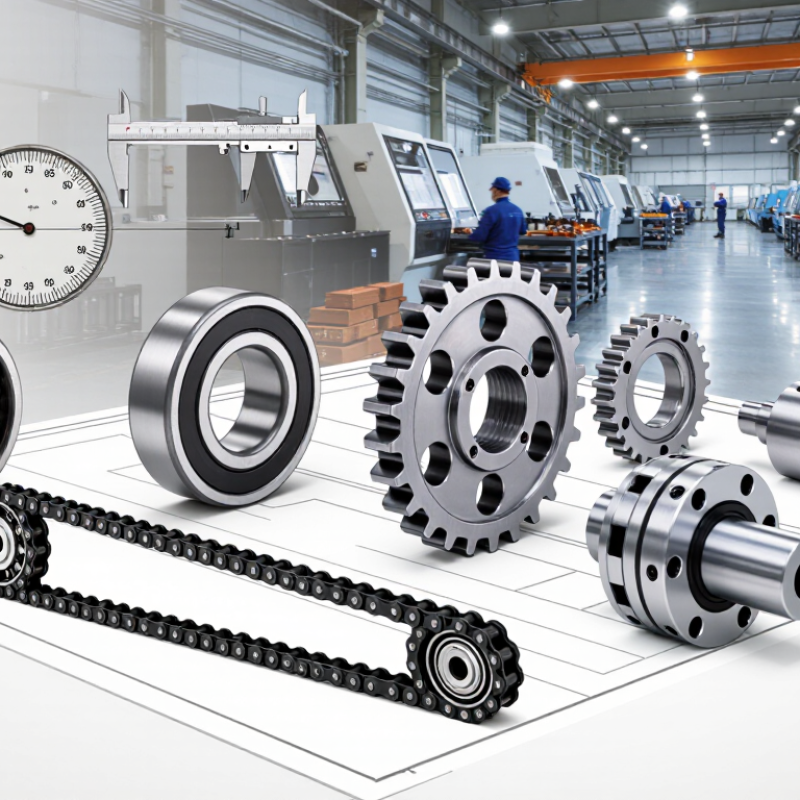
Power Transmission Parts: Types, Functions, and Applications
China Best Power Transmission Parts Manufacturers
Power transmission parts move mechanical energy between machines, shafts, and driven equipment. Their job sounds simple. In practice, small errors can create heat, vibration, and premature wear. Common parts include gears, couplings, belts, chains, sprockets, shafts, and bearings. Gears adjust speed and torque, while couplings connect shafts and absorb limited misalignment. Belts operate quietly over longer distances, whereas chains suit heavier loads and harsher conditions.
Each application needs a careful match between load, speed, environment, and maintenance access. A conveyor may use hardened sprockets and roller chains for repeated movement. A packaging machine often needs precise timing belts and low-vibration pulleys. Pumps, compressors, and industrial fans commonly depend on aligned shafts, flexible couplings, and properly rated bearings. Lubrication matters too. Too little increases friction; too much can raise operating temperature.
Experienced manufacturers usually verify dimensions, material hardness, surface finish, and balancing before shipment. Practical inspection may include torque testing, runout measurement, and visual checks for cracks or burrs. Clear drawings and traceable quality records improve purchasing reliability. Still, a component can pass inspection and perform poorly after incorrect installation. That uncomfortable detail deserves attention. Shaft alignment, tension, lubrication, and replacement intervals should be recorded at the worksite. In my experience, maintenance teams often focus on the part, while the surrounding system receives less scrutiny.
China’s Power Transmission Manufacturing Industry
China Best Power Transmission Parts Manufacturers
China’s power transmission manufacturing industry is moving from volume production toward measured precision. The China Machinery Industry Federation reported 6.8% growth in equipment manufacturing value added during 2023. That expansion supports demand for gears, couplings, bearings, chains, pulleys, and industrial reducers.
Electricity demand keeps the supply chain busy. The China Electricity Council recorded national electricity consumption of 9.85 trillion kWh in 2024, rising 6.8% year on year. This growth increases pressure on factory drives, conveyor systems, generation equipment, and maintenance inventories. Manufacturers now use CNC machining, heat treatment, coordinate measurement, and digital inspection to control tooth profiles and shaft alignment. Small errors become expensive vibration.
Production scale is not enough. The China Association of Machinery Industry’s 2024 analysis highlighted continuing weaknesses in high-end components, including material consistency and core process capability. That criticism matters. A supplier may offer excellent samples, yet struggle with stable batch performance. Buyers should check hardness records, runout data, load testing, traceability, and replacement lead times. Factory visits reveal practical details: clean assembly benches, calibrated gauges, sealed storage, and operators who understand failure modes. Documentation can still be incomplete. That is where careful sourcing becomes necessary.
Key Criteria for Evaluating Chinese Manufacturers
A reliable power transmission parts manufacturer should provide clear technical records, not just polished product photos. Review material grades, heat-treatment details, dimensional tolerances, and inspection reports. These records help buyers compare components such as gears, shafts, and couplings against actual operating requirements. Ask how the factory controls hardness and runout. Small deviations can cause vibration or uneven wear.
Look closely at production capability. Request a sample and inspect its finish, keyway dimensions, and fit with mating parts. Ask whether critical measurements are checked with calibrated instruments and whether test results can be traced to a production batch. A short factory audit can reveal more than a broad sales presentation. Still, one sample cannot prove consistent quality across every shipment. That limitation matters.
Experience with similar loads and environments is valuable. Discuss speed, torque, temperature, dust, and maintenance access before accepting a recommendation. A technically sound supplier should explain trade-offs in plain language and respond with drawings or measurable data. Check lead times, packaging, and procedures for handling defects. Communication may be slower than expected, and that is worth examining early. Price matters, but a low quote means little without dependable inspection and practical after-sales support.
Major Product Categories and Manufacturing Capabilities
China Best Power Transmission Parts Manufacturers
Major Product Categories and Manufacturing Capabilities
Power transmission parts must handle mechanical loads, electrical stress, weather, and long service cycles. Major categories include suspension and strain insulators, line fittings, clamps, connectors, vibration dampers, spacers, and tower hardware. Manufacturers may use forging, casting, stamping, CNC machining, and hot-dip galvanizing. These processes shape parts for overhead lines and substations. Quality checks can include dimensional inspection, coating-thickness measurement, tensile testing, and electrical testing where relevant. A polished finish is useful, but it does not prove dependable performance.
The International Energy Agency’s 2023 report, Electricity Grids and Secure Energy Transitions, says annual grid investment must rise to more than US$600 billion by 2030 to meet its grid expansion scenario. That need puts attention on component capacity and consistent quality. Buyers can review material traceability, production controls, test records, and the supplier’s ability to manage custom drawings. Capabilities vary, though. A large factory is not automatically the right fit for every project.
Tips: Match each part to its specified load, conductor size, environment, and installation method. Ask for test evidence tied to the actual product, not only a general quality certificate. Check coating coverage around holes and edges; these small areas can be missed. Also confirm tolerances before ordering. A little extra verification can prevent costly site adjustments.
