
How to Choose the Right Fuel Oil Heater?
Choosing the right Fuel Oil Heater begins with the room, not the product label. A cold workshop, a rural home, and a temporary site require different heating strategies. Measure the space carefully. Note ceiling height, insulation, door gaps, and local winter temperatures. A heater that is too small may run constantly. One that is too large can waste fuel and create uneven heat.
Dan Holohan, a respected heating educator and writer, offers a practical reminder: “Comfort is the goal, not heat.” That idea matters when comparing output ratings, burner performance, controls, and noise levels. Look for a model with dependable ignition, accessible filters, clear operating instructions, and suitable ventilation requirements. Check whether its fuel tank, pump, nozzle, and electrical controls are easy to inspect. Small details matter.
Safety cannot be treated as an afterthought. Confirm professional installation requirements, carbon monoxide protection, safe clearances, and routine service support. Consider fuel availability, delivery costs, emissions information, and warranty terms. A higher output rating does not automatically mean better performance. It may simply mean higher consumption.
There is no perfect choice.
Even experienced buyers can overlook changing fuel prices or future room renovations. I have seen impressive heaters perform poorly in spaces with open doors and weak insulation. That is why this guide compares real operating conditions, not just brochure claims. The right Fuel Oil Heater should deliver steady warmth, manageable running costs, and confidence during the coldest hours. Evaluate evidence carefully, ask qualified technicians precise questions, and leave room to reconsider your first assumption.
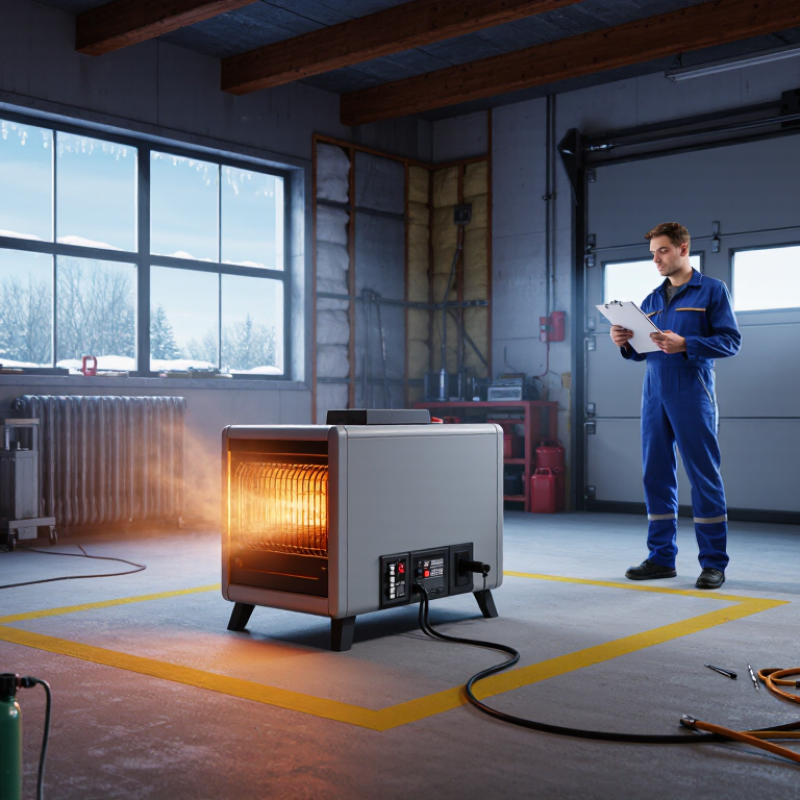
Understanding Fuel Oil Heater Types and Heating Applications
How to Choose the Right Fuel Oil Heater?
Choosing a fuel oil heater starts with the heating application, not the heater’s advertised output. Direct-fired heaters release warm air and combustion gases into the space. They suit open workshops, construction areas, and well-ventilated agricultural buildings. Indirect-fired heaters transfer heat through a chamber and vent exhaust outside. They work better in enclosed rooms, temporary offices, and spaces needing cleaner air.
Portable models offer fast setup and flexible positioning. Ducted systems distribute heat across larger areas, although installation takes more planning. Check the room volume, insulation, target temperature, and local climate before selecting capacity. An oversized heater may cycle too often and waste fuel. An undersized unit may run continuously. In practical site checks, airflow is often overlooked. That mistake can create cold corners, even when the heater feels powerful.
Tips: Measure the space twice. Confirm ventilation requirements and exhaust routing. Use a thermostat for steadier temperatures. Keep fuel containers clean and protected from water. Inspect hoses, filters, and connections before operation. Never place a heater near stored materials or blocked exits. I have found that real conditions differ from design drawings. A doorway may stay open, or insulation may be incomplete. Recheck the heating plan after installation, and adjust the unit’s position when air movement changes.
How to Choose the Right Fuel Oil Heater? - Understanding Fuel Oil Heater Types and Heating Applications
| Heater Type | Typical Heat Output | Heating Method | Recommended Applications | Ventilation Requirement | Main Advantages | Important Limitations |
|---|---|---|---|---|---|---|
| Direct-Fired Forced-Air Heater | Approximately 20–400 kW, depending on model | A fan distributes heated combustion air directly into the space | Construction sites, workshops, agricultural buildings, warehouses, and temporary heating | High ventilation is required because combustion products enter the heated area | Rapid warm-up, high mobility, simple installation, and nearly all fuel energy becomes useful heat indoors | Not suitable for occupied areas with limited ventilation or where clean air is essential; adds moisture and exhaust gases |
| Indirect-Fired Forced-Air Heater | Approximately 20–350 kW, depending on model | A heat exchanger separates combustion gases from the heated air | Event spaces, commercial buildings, occupied workshops, warehouses, and enclosed work areas | Requires a flue or exhaust duct to discharge combustion gases outdoors | Provides cleaner, drier heated air and is more appropriate for occupied spaces | More expensive and less energy-efficient than direct-fired units because heat leaves through the flue; installation is more complex |
| Oil-Fired Hydronic Heater | Commonly about 15–300 kW for building heating systems | Burns fuel oil to heat water or another approved heat-transfer fluid for radiators, fan coils, or underfloor systems | Homes, offices, schools, workshops, and buildings with existing hydronic distribution | Requires a properly sized flue, combustion-air supply, and a suitable mechanical room | Even heat distribution, quiet operation in occupied rooms, and compatibility with multiple heat emitters | Higher installation cost, slower response than direct air heaters, and regular boiler and water-system maintenance |
| Oil-Fired Warm-Air Furnace | Approximately 20–150 kW for many building applications | A burner heats a heat exchanger, and a blower distributes warm air through ducts | Residential and light-commercial buildings that already have ductwork | Requires a flue, combustion-air provisions, and adequate return-air and supply-air ducting | Fast response, centralized temperature control, and the ability to integrate filtration or ventilation equipment | Duct installation can be costly; airflow may create noise and distribute dust if filters are not maintained |
| Oil-Fired Cabinet or Unit Heater | Typically about 20–150 kW | A compact burner and heat exchanger deliver warm air directly or through a short duct system | Garages, workshops, small warehouses, service areas, and agricultural buildings | Usually needs a flue and dedicated combustion-air provisions; requirements vary by installation | Compact footprint, direct space heating, and relatively straightforward zoning for individual areas | Can cause temperature stratification, requires clearance from combustibles, and is not ideal for large multi-zone buildings without ducting |
| Oil-Fired Radiant Heater | Commonly about 10–100 kW | Radiant surfaces or tubes transfer infrared heat directly to people, floors, and objects | High-bay workshops, loading areas, partially open buildings, and zones with frequently open doors | Requires a flue or approved exhaust arrangement and adequate combustion air | Heats occupants and surfaces directly, reduces losses from air movement, and performs well in tall or drafty spaces | Uneven comfort may occur outside the radiation pattern; equipment placement and combustible-clearance rules are critical |
| Condensing Oil Boiler or Heater | Often about 15–100 kW in building heating applications | Recovers latent heat from water vapor in the flue gases by operating with sufficiently low return temperatures | Well-insulated buildings, low-temperature radiators, and underfloor heating systems | Requires a compatible flue system, condensate drainage, and treatment where required by local regulations | Can achieve higher seasonal efficiency than conventional non-condensing equipment when correctly designed and operated | Higher design complexity, acidic condensate management, and reduced condensation benefits at high water temperatures |