
How to Choose the Right Water Chiller Evaporator?
Choosing the right Water Chiller Evaporator is not simply a matter of selecting the largest heat-transfer surface. The decision affects cooling capacity, energy use, maintenance, and equipment life. A well-matched evaporator keeps chilled water stable, even when process loads change during the day. An incorrect choice may cause high pressure drop, poor heat transfer, or repeated compressor cycling.
Start with real operating conditions. Record the required cooling load, chilled-water flow rate, inlet and outlet temperatures, refrigerant type, and expected ambient conditions. These figures should come from measured plant data whenever possible. A calculation based only on a nameplate can be misleading. It looks precise. It may not be.
Shell-and-tube, brazed plate, and flooded evaporators each suit different applications. Brazed plate units are compact and efficient, but water quality and service access require careful review. Shell-and-tube designs often offer stronger maintenance flexibility, especially in larger systems. Flooded models can deliver excellent performance, but they need suitable refrigerant management and skilled commissioning.
A reliable selection also considers fouling risk, freeze protection, materials, control response, and future capacity changes. Experienced engineers compare manufacturer performance tables with recognized testing requirements and site conditions. They also check whether the stated capacity remains valid at the actual flow rate. Small details matter here. A two-degree temperature assumption can change the result significantly.
This guide explains how to compare evaporator designs with practical engineering judgment. It also highlights common selection mistakes, because even experienced teams can overlook installation limits, seasonal loads, or water-treatment problems. Performance on paper is only the beginning.
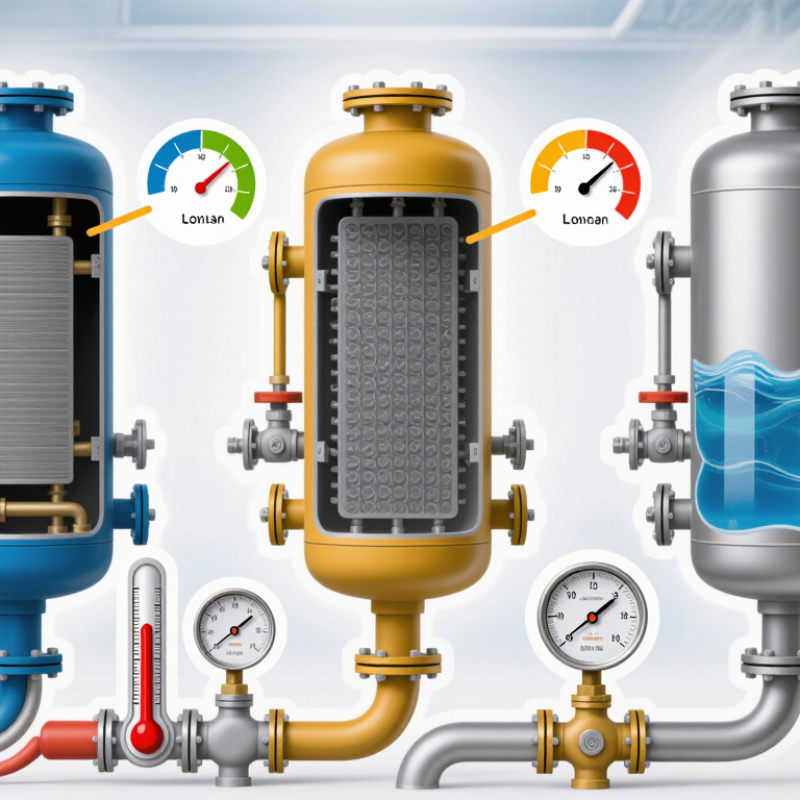
Evaporator Basics and Their Role in Water Chiller Performance
In a water chiller, the evaporator is where liquid refrigerant absorbs heat from circulating water. This heat exchange strongly affects cooling efficiency and stability. I have found that many selection errors begin with capacity alone. A unit rated for the correct cooling load may still perform poorly if its water flow, refrigerant circuit, or approach temperature is unsuitable. The evaporator needs careful matching. Small details matter.
Flooded evaporators keep the heat-transfer surface wet, often supporting strong efficiency at steady loads. Direct-expansion designs meter refrigerant through tubes and can offer a compact arrangement. Neither type is automatically best. Consider entering and leaving water temperatures, seasonal load changes, allowable pressure drop, and maintenance access. Tube material matters when water chemistry is aggressive. Strainers, filtration, and regular inspection help limit fouling, which acts like an unwanted blanket over the tubes.
During commissioning, record water flow, temperature difference, suction pressure, and superheat. Compare those readings with the design data, not guesswork. A rising approach temperature can signal fouling, low flow, or refrigerant imbalance. I once focused too heavily on nominal efficiency and overlooked cleaning access. That decision created avoidable downtime. The better question is practical: can technicians verify performance and service the evaporator without disrupting the entire chiller?
Key Factors for Matching Evaporator Capacity to System Requirements
How to Choose the Right Water Chiller Evaporator?
Key Factors for Matching Evaporator Capacity to System Requirements
Evaporator capacity must match the building’s real cooling load, not only the chiller’s nameplate. The IEA’s The Future of Cooling report projects global cooling demand could more than triple by 2050. That pressure makes accurate selection increasingly important. Calculate heat removal with water flow, specific heat, and temperature difference. A larger evaporator is not automatically safer.
Use design data from the operating system. Confirm peak flow, entering water temperature, leaving water temperature, glycol concentration, and expected fouling. ASHRAE Handbook—Fundamentals identifies water’s specific heat near 4.18 kJ/kg·K under common conditions. Even small changes in flow can alter capacity. A 10% flow increase may not deliver 10% more useful cooling if the load is already limited.
Check rating conditions carefully. AHRI Standard 550/590-2020 evaluates many water-cooled chillers around 44°F leaving chilled water and 85°F entering condenser water. Actual sites may run warmer, dirtier, or with lower flow. That difference matters. Oversizing can reduce operating hours and create unstable cycling. Undersizing can leave a process tank warm during afternoon demand. Field commissioning often reveals an uncomfortable truth: the spreadsheet was tidy, but the sensors were poorly placed. Review measured temperatures and pressure drops before finalizing the evaporator. A modest safety allowance is useful, but an unexplained allowance deserves another question.
Comparing Common Evaporator Designs and Heat Transfer Methods
How to Choose the Right Water Chiller Evaporator?
Evaporator design controls efficiency, maintenance, and stable leaving-water temperature. Shell-and-tube units suit larger systems because refrigerant surrounds water tubes. Their robust construction tolerates pressure changes and moderate fouling. Plate-and-frame designs provide compact heat transfer through thin corrugated plates. They can deliver high efficiency with a smaller footprint, but poor water quality may increase blockage risks. Direct-expansion evaporators usually reduce refrigerant volume. However, refrigerant distribution becomes more sensitive.
Heat transfer method matters as much as geometry. Flooded evaporators keep tubes immersed in liquid refrigerant, supporting strong boiling and low temperature differences. They often need reliable oil return and careful refrigerant control. DX evaporators feed refrigerant through tubes, where boiling occurs along the flow path. This design can simplify oil management, yet uneven distribution may reduce performance. ASHRAE Handbook—HVAC Systems and Equipment identifies refrigerant-side boiling, water velocity, and fouling resistance as key selection variables.
Energy pressure is growing. The International Energy Agency’s The Future of Cooling report projects global space-cooling electricity demand could triple by 2050 without efficiency improvements. That makes a small approach-temperature reduction meaningful. Still, the best design is not always the most efficient on paper. Field conditions, water chemistry, cycling frequency, and service access can change the result. A plate evaporator may win in a clean process loop, while a shell-and-tube unit may survive better beside dusty cooling towers. Check the assumptions.
Selecting Materials for Water Quality, Durability, and Maintenance
Choosing an evaporator material starts with water chemistry, not purchase price.
Copper tubes suit many treated freshwater systems and transfer heat efficiently. However, ammonia, low pH, or excessive oxygen can accelerate copper corrosion.
Stainless steel offers stronger resistance, but chloride-rich water can still cause pitting. Titanium is often safer for seawater or brackish applications, although its initial cost is higher.
Test the water before selecting the metal. Record pH, chloride, hardness, conductivity, and biological activity.
The U.S. EPA lists 500 mg/L as a secondary drinking-water guideline for total dissolved solids, but chilled-water circuits may require tighter control.
Do not treat this value as a universal limit.
ASHRAE’s 2024 HVAC Systems and Equipment Handbook stresses that water treatment, flow velocity, and fouling control must be evaluated together. A material chart alone is insufficient.
Maintenance access matters as much as corrosion resistance. Choose removable heads, cleanable tube surfaces, and inspection ports where possible.
Copper may simplify mechanical cleaning, while titanium demands careful protection from surface damage.
AMPP’s IMPACT study estimates global corrosion costs at about 3.4% of global GDP, or approximately $2.5 trillion annually. Small chemistry mistakes can become expensive failures.
Field records often expose an uncomfortable truth: the “best” material can fail when operators ignore conductivity drift or biological growth. Recheck water conditions seasonally, especially after makeup-water changes.
Evaluating Efficiency, Installation Needs, and Long-Term Operating Costs
Choosing a water chiller evaporator starts with efficiency, not the lowest purchase price. The International Energy Agency reported that global cooling demand could more than triple by 2050, reaching about 6,200 TWh annually. Small efficiency losses may therefore become expensive over time. Compare full-load and part-load performance using AHRI Standard 550/590 ratings, including IPLV or NPLV values. A flooded evaporator can provide strong heat transfer, while a plate-and-frame design may reduce space and installation time. The best choice depends on water quality, load variation, and available maintenance access.
Installation details often decide real performance. Keep enough clearance for tube cleaning, valve replacement, and sensor calibration. Confirm flow rates before selecting the evaporator. Low flow can cause unstable control, while excessive flow increases pump energy. The U.S. Department of Energy’s energy-efficiency guidance repeatedly highlights pumping and heat-transfer optimization as major lifecycle opportunities. In practice, fouling is easy to underestimate. A clean system may perform well during commissioning, then slowly lose capacity in dusty or poorly treated environments. I would not assume laboratory efficiency will survive every operating season.
Tips: Request a lifecycle-cost model covering electricity, water treatment, cleaning, downtime, and replacement parts. Check the installer’s commissioning procedure. Ask for measured entering and leaving water temperatures, not only catalog values. Leave room for mistakes; maintenance teams may need more access than designers expect. Use current energy tariffs and realistic annual operating hours. Forecasts can be wrong. Your assumptions should be easy to revise.
How to Choose the Right Water Chiller Evaporator? - Evaluating Efficiency, Installation Needs, and Long-Term Operating Costs
Representative engineering ranges for common water-chiller evaporator designs
| Evaluation Dimension | Brazed Plate Evaporator | Flooded Shell-and-Tube | DX Shell-and-Tube | Plate-and-Frame Evaporator |
|---|---|---|---|---|
| Typical application | Compact packaged chillers and small-to-medium comfort-cooling systems | Medium-to-large chillers requiring high efficiency and stable performance | Packaged systems with moderate capacity and simple refrigerant circuits | Industrial process cooling, variable fluid duties, and systems needing service access |
| Typical cooling-capacity range | Approximately 5–1,000 kW | Approximately 200–10,000+ kW | Approximately 100–3,000 kW | Approximately 50–5,000 kW |
| Typical water-side pressure drop | Approximately 30–80 kPa at design flow | Approximately 40–100 kPa at design flow | Approximately 30–90 kPa at design flow | Approximately 20–80 kPa at design flow; depends strongly on plate spacing |
| Approach temperature | Commonly about 1–3°C in well-designed systems | Commonly about 0.5–2°C, supporting strong thermodynamic efficiency | Commonly about 1–3°C | Commonly about 1–3°C; depends on pass arrangement and fouling condition |
| Relative heat-transfer efficiency | High; counter-current flow and turbulent channels provide strong heat transfer | Very high; flooded refrigerant operation provides excellent surface utilization | High; performance is generally below flooded designs at comparable conditions | High; performance can be adjusted by changing plate count and pass configuration |
| Physical size and weight | Very compact and lightweight; often the smallest option for a given duty | Large and heavy, especially at high capacity; requires substantial support | Moderate to large; generally heavier than brazed-plate designs | Compact compared with shell-and-tube; frame space is needed for plate removal |
| Installation requirements | Simple piping layout; requires clean water, correct flow control, and freeze protection | Requires adequate floor loading, lifting access, refrigerant controls, and oil-return design | Requires refrigerant distribution, oil-return provisions, and sufficient service clearance | Requires accessible withdrawal space for plates and a rigid, level installation base |
| Water-quality sensitivity | High; narrow passages can be affected by scale, debris, and poor filtration | Moderate; larger tubes are more tolerant, but fouling still reduces capacity and efficiency | Moderate; tube-side fouling and corrosion must be controlled | High to moderate; plate channels require filtration and suitable water treatment |
| Cleaning and maintenance | Usually cleaned chemically in place; mechanical cleaning is limited | Tube brushing or chemical cleaning is practical; inspection access is generally good | Tube cleaning is practical; refrigerant-side service requires qualified technicians | Excellent serviceability; plates can be opened, inspected, cleaned, or replaced |
| Initial equipment cost | Low to medium, depending on materials, refrigerant pressure, and capacity | High; larger vessels, controls, and refrigerant charge increase installed cost | Medium to high | Medium; frame and plate materials strongly affect cost |
| Long-term operating cost | Low when water is clean; fouling can quickly increase pump and compressor energy | Often low at high load because of efficient heat transfer and stable operation | Moderate; energy use and maintenance depend on refrigerant distribution and fouling | Low to moderate; cleaning is efficient, but gasket and plate replacement may add cost |
| Expected service life | Approximately 10–20 years with suitable water treatment and freeze protection | Approximately 20–30 years with proper corrosion control and maintenance | Approximately 20–30 years with appropriate tube materials and maintenance | Approximately 15–25 years; gaskets may require periodic replacement |
| Best choice when | Space is limited, the water circuit is clean, and compactness is a priority | The system is large, efficiency is critical, and professional maintenance is available | A conventional, robust design is needed for medium-capacity packaged equipment | The process fluid varies, frequent cleaning is expected, or future capacity changes are likely |
