
Request A Quote

Phone: 416-244-6476
Email:

    China Top TT Racket Manufacturers for Global Buyers

    Choosing a reliable Chinese supplier takes more than comparing prices or browsing polished product photos. For global buyers, the right Tt Racket manufacturer should match the intended player, market, and order size. A club seeking durable training rackets may value different features than a brand developing competition-focused equipment. Small details matter: blade-ply construction, handle shape, rubber options, finished weight, and packaging can all affect the final product.

    This guide introduces leading manufacturers and practical ways to assess them. Buyers can compare product ranges, customization services, production capabilities, quality-control processes, and export experience. Ask for clear specifications and a recent sample. Test its balance, grip comfort, surface finish, and consistency before discussing larger orders. Then confirm how the supplier checks production batches and handles defects. Details build confidence.

    A strong catalog is not enough. Neither is a reassuring sales conversation. One sample cannot prove that every unit will match, so buyers should ask how specifications are maintained across a full production run. Communication also deserves attention: timely, precise answers often reveal how smoothly development may proceed. No single factory suits every buyer, and the lowest quotation may leave important questions unanswered. This overview offers a grounded starting point, not a guarantee. Verify claims directly, compare evidence, and consider the needs of your own customers before choosing a partner.
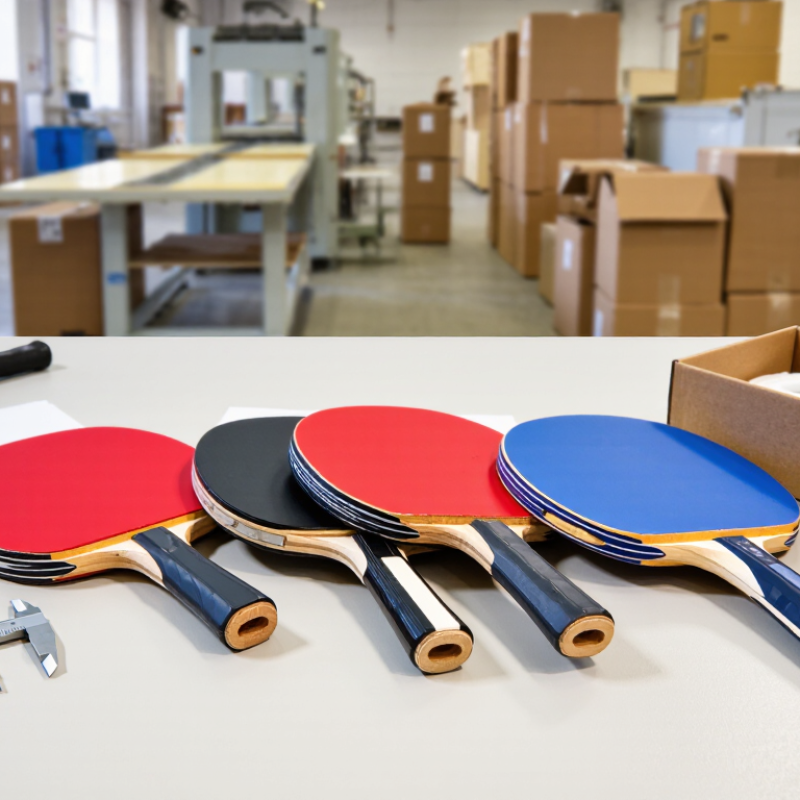
    China Top TT Racket Manufacturers for Global Buyers

    Overview of China’s Table Tennis Racket Manufacturing Industry

    China Top TT Racket Manufacturers for Global Buyers

    Overview of China’s Table Tennis Racket Manufacturing Industry

    China’s table tennis racket industry combines material processing, component sourcing, assembly, and export services. Manufacturers may produce blade layers, shape handles, bond rubber sheets, and package finished rackets within connected supply networks. Production methods vary, from hand-finishing selected blades to machine-controlled cutting and sanding. That variety gives buyers options, but makes supplier comparison important.

    A reliable review looks beyond catalog photos. Ask about blade construction, rubber specifications, handle dimensions, and sample inspection procedures. Check whether production samples match the quoted materials and finish. On a finished racket, uneven edges, excess adhesive, or a loose handle can reveal quality-control gaps. Still, a neat sample cannot guarantee every batch will be identical. That deserves attention.

    Tips: Request a written specification and a pre-shipment inspection plan. Compare several samples in play, not just by appearance. Keep records of approved materials and dimensions.

    Main Racket Types, Materials, and Production Capabilities

    China’s table tennis racket factories commonly produce bare blades, assembled rackets, and custom configurations. Blade-only orders suit players who select rubber separately. Preassembled models combine a blade, sponge, and rubber sheet for convenient use. Buyers can also specify handle shapes, grip finishes, and packaging. Small details matter.

    Most blades use layered wood, sometimes combined with carbon or other fiber materials. Factory processes may include veneer selection, glue application, hot pressing, sanding, and handle fitting. Rubber assembly involves choices such as sponge thickness, sheet cutting, and bonding. Production capacity varies; some workshops handle small trial runs, while larger lines support repeat orders. A fast line is not always a consistent one.

    For supplier evaluation, request samples made to the intended specification. Check weight, blade thickness, handle fit, rubber alignment, and edge finish. Ask how the factory records material batches and checks products during production. A polished specification sheet can still overlook unit-to-unit variation. That gap deserves attention. A second sample may reveal what the first one missed.

    China Top TT Racket Manufacturers for Global Buyers - Main Racket Types, Materials, and Production Capabilities

    Racket Type Typical Construction Common Materials Typical Production Capabilities Common Buyer Options
    All-wood shakehand blade Multi-ply wooden blade with a flared, straight, or anatomical handle Common blade woods include limba, ayous, kiri, and hinoki; handle parts may use wood or composite materials Veneer selection and lay-up, pressing, blade shaping, sanding, handle assembly, finishing, and weight or thickness checks Ply arrangement, handle shape, handle color, blade dimensions, surface finish, and packaging
    Composite shakehand blade Wooden plies combined with one or more fiber-composite layers Wood veneers with carbon-fiber or other fiber-composite layers, depending on the design Composite-layer cutting and placement, controlled pressing, blade finishing, handle fitting, and product inspection Composite layer type and placement, ply structure, handle style, finish, and retail presentation
    Penhold blade Blade designed for a penhold grip, with a compact handle shape Wood veneers; some designs may include fiber-composite layers Blade lay-up and pressing, penhold handle shaping, sanding, edge finishing, and assembly Handle profile, blade shape, ply construction, surface finish, and packaging format
    Pre-assembled recreational racket Blade supplied with sponge and rubber coverings already attached Wood or composite blade, sponge layer, and rubber sheet with a pimpled playing surface Blade production or sourcing, rubber cutting and bonding, handle finishing, edge-tape application, and set packing Rubber color, handle style, edge tape, protective packaging, and racket-and-ball set configuration
    Custom blade or private-label project Blade or racket made to buyer-supplied drawings, samples, or agreed specifications Selected wood veneers, optional fiber-composite layers, handle materials, rubber, and packaging materials Specification review, sampling, material selection, production, logo or artwork application, inspection, and export packing; availability depends on the supplier Artwork, handle design, construction, packaging, inspection criteria, and order quantity, subject to supplier capability

    Notes: Construction, materials, customization, and production processes vary by supplier and order. For competition use, confirm that the specific racket and its coverings meet the applicable rules; approval or compliance should not be assumed for every model.

    Leading Chinese Manufacturers and Their Areas of Expertise

    Chinese table tennis racket manufacturers often specialize in different parts of production. Some focus on wooden blades, selecting and bonding layers such as limba or ayous for distinct feel and control. Others work with carbon-composite construction, where fiber placement can change stiffness and response. Rubber assembly and ready-to-play rackets are separate strengths. Details matter. Buyers should match a supplier’s capabilities to their intended player level and sales channel.

    For bulk orders, ask how the factory controls weight, balance, handle shape, and rubber bonding across batches. Request samples with recorded specifications, then compare several units rather than judging one racket. A manufacturer offering custom packaging may not also excel at blade design. Catalogs can look convincing, but production consistency needs evidence. Even careful sampling has limits; a small test order may reveal issues that a single sample cannot.

    Tips: Share target weight, blade feel, handle dimensions, and rubber preferences in writing. Ask for a sample approval process and batch inspection records. Keep the first order modest. A clear specification sheet prevents avoidable misunderstandings.

    Quality Standards, Customization, and Export Readiness

    Global buyers evaluating Chinese table tennis racket manufacturers should inspect documented process controls, not just polished samples. The International Table Tennis Federation’s Laws of Table Tennis specify racket requirements, including blade composition and covering thickness. Ask suppliers to match checks to current ITTF rules when products target sanctioned competition. Small details matter: blade flatness, handle balance, rubber adhesion, and clean edge finishing.

    Request batch records for weight, bonding, and packaging checks. Custom orders should define handle shape, blade plies, rubber characteristics, print placement, carton markings, and acceptable variation. Approve a preproduction sample and retain a reference unit. One sample is not proof. Ask how the factory manages changes in materials or production settings. This question can feel tedious, but it may prevent costly inconsistencies.


    Export readiness also means confirming lead times, carton dimensions, packing lists, and destination-specific document needs before production. The WTO’s October 2024 Global Trade Outlook and Statistics reported a 1.2% drop in world merchandise trade volume in 2023, then forecast growth of 2.6% for 2024. Forecasts are not guarantees. Buyers should confirm shipping plans and delivery buffers for each order, rather than assume past schedules will hold.

    How Global Buyers Can Evaluate and Select a Supplier

    Global buyers should assess a table tennis racket supplier against measurable requirements, not catalog claims. The ITTF Handbook 2024 states that at least 85% of a racket blade’s thickness must be natural wood. It also limits sandwich rubber to 4.0 mm and ordinary pimpled rubber to 2.0 mm, including adhesive. Ask suppliers for material declarations and dimensional inspection records. Check that proposed coverings appear on the ITTF’s current authorized list when competition approval matters. Small details matter. A sample may pass, while a later production batch varies.

    Evaluate manufacturing consistency with a documented checklist. Request measurements from several production lots, including racket weight, blade thickness, handle dimensions, and balance point. Inspect edge sanding and handle bonding under bright light; loose joints or rough edges can reveal weak process control. Ask how the factory records incoming materials, rejects defects, and traces batches. Verify any quality-management certificate with its issuer, and confirm that its scope covers the relevant production site. Certificates alone do not prove racket performance. Samples can mislead. I would also allow time for a repeat inspection; that step is easy to skip when deadlines tighten. Cite technical limits against the ITTF Handbook, and record agreed tolerances in the purchase specification.