
Request A Quote

Phone: 416-244-6476
Email:

    Top Hand Forged Skillet Manufacturers for Global Buyers

    Choosing the right Hand Forged Skillet manufacturer requires more than comparing prices. Global buyers need dependable craftsmanship, consistent materials, and clear production evidence. A well-made skillet should feel balanced in the hand, show an even cooking surface, and develop useful seasoning over time. Small details matter, including handle attachment, rim thickness, surface texture, and packaging protection.

    This guide examines manufacturers through practical purchasing criteria. These include forging methods, carbon steel or cast iron specifications, heat-treatment controls, quality inspections, customization capacity, minimum order quantities, and export experience. Reliable suppliers should explain their testing procedures and provide traceable product information. Factory photographs, sample orders, audit records, and responsive communication can reveal more than polished catalog pages.

    Look beyond attractive claims.

    A supplier may offer excellent samples but struggle with larger production runs. Another may provide competitive pricing while leaving coating, labeling, or shipping responsibilities unclear. That gap deserves attention. Manufacturer rankings can also change as equipment, management, and market conditions evolve. Therefore, this overview should support careful verification rather than replace it. Buyers should confirm current certifications, material reports, production timelines, and destination-market requirements before signing contracts. The strongest manufacturers combine traditional forging knowledge with modern quality control. They also understand that a skillet entering a professional kitchen or home market must perform reliably after repeated heating, washing, and seasoning. This practical balance guides the selection of leading manufacturers for global buyers.
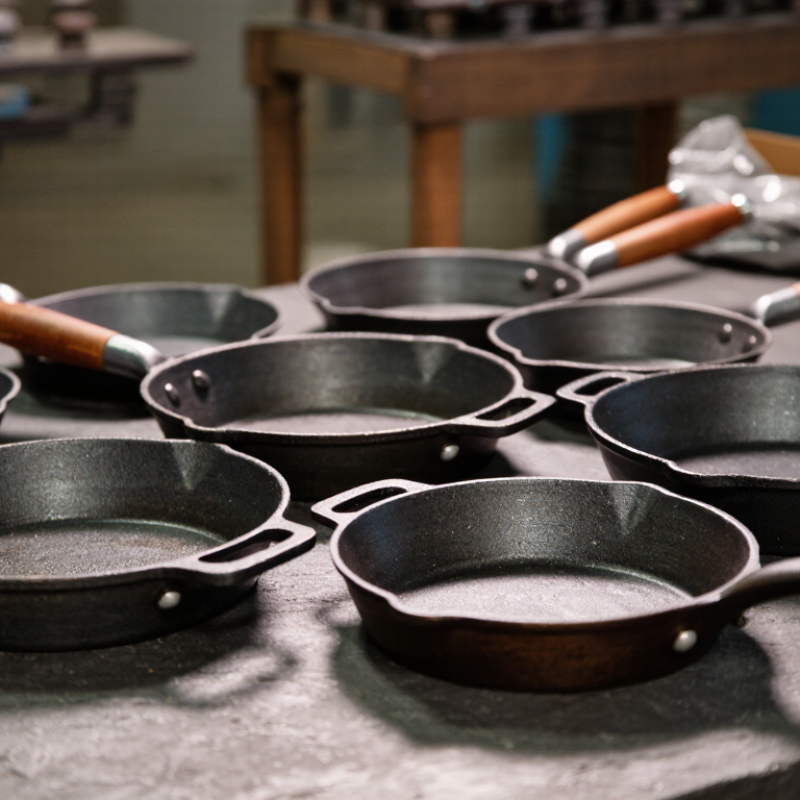
    Top Hand Forged Skillet Manufacturers for Global Buyers

    Hand-Forged Skillets: Iron Grades, 2–5 mm Walls, and Heat Performance

    For global buyers, “hand-forged” should describe a process, not replace a material specification. Common options include low-carbon wrought iron and carbon steel, often near AISI 1008–1018. Their low carbon content supports ductility, while 1045-type steel offers greater hardness but demands tighter forging control. ASTM grades and AISI designations provide useful references, yet neither proves food-contact suitability or uniform thickness. Request mill certificates, carbon range, hardness, and coating declarations from each manufacturer. Small details matter.

    Wall thickness changes cooking behavior more than marketing language suggests. A 2 mm skillet heats quickly and follows burner adjustments, but hot spots appear sooner. A 5 mm wall stores more energy and resists temperature loss when cold food enters. ASM Handbook material data places plain carbon steel conductivity broadly near 45–60 W/m·K at room temperature, depending on grade and condition. DOE heat-transfer guidance connects greater thermal mass with slower temperature change, although pan geometry complicates results. In factory trials, measure center-to-edge temperature using surface probes or calibrated infrared equipment. Do not trust one reading. A 3 mm base with a reinforced 5 mm wall may outperform a uniformly thick pan, but that assumption needs verification. Variations in forging pressure, residual stress, and seasoning thickness can quietly change performance.

    Global Trade Scope: HS 7323 Data, Export Values, and Buyer Demand

    For global buyers, HS 7323 offers a practical starting point for studying hand forged skillet trade. The category generally covers household and kitchen articles made from iron or steel. Classification can differ between customs authorities. Verify each destination’s tariff schedule before comparing suppliers. This prevents costly data errors.

    Export value data reveals more than supplier scale. Compare annual export values, shipment quantities, and calculated unit values by origin. A higher unit value may reflect heavier iron, better finishing, stronger packaging, or different freight terms. Always check whether figures use FOB, CIF, or another valuation basis. The numbers help, but they are never perfectly clean. Mirror statistics can expose gaps between exporter and importer records.

    Buyer demand appears through repeat shipments, destination growth, and seasonal purchasing patterns. Retailers often request 20 to 30 centimeter pans, stable handles, and pre-seasoned surfaces. Commercial kitchens may prefer thicker walls and consistent dimensions. Buyers should request samples, material declarations, coating details, and inspection records before placing volume orders. Hand forged claims also deserve process evidence, not only attractive photographs. Small weight differences can noticeably change freight costs. That detail is easy to underestimate.

    Manufacturer Ranking: Output Capacity, MOQ, ISO 9001, and QA Metrics

    When global buyers rank hand forged skillet manufacturers, output capacity is a useful starting point, not a verdict. A plant producing 20,000 units monthly may handle stable retail programs. Yet capacity can hide subcontracting, seasonal labor, or unfinished inventory. Ask for three months of production records. Confirm furnace schedules, forging stations, finishing lines, and packing space during a live video audit. In my sourcing experience, visible workflow often explains delays better than a polished brochure.

    MOQ should match the buyer’s testing plan and cash flow. A 300-piece MOQ may suit a regional launch, while 3,000 pieces can reduce unit cost but increase storage risk. Request MOQ details by size, handle style, seasoning treatment, and packaging format. Small pilot orders reveal warping, rough rims, uneven seasoning, and handle misalignment. They also show whether the factory treats inspection seriously. Do not ignore lead-time promises. A low MOQ means little if replenishment takes ten weeks.

    ISO 9001 indicates a documented quality system, but the certificate alone proves limited practical control. Check its validity, scope, issuing body, and manufacturing address. More useful QA metrics include first-pass yield, defect rate, corrective-action closure time, seasoning consistency, and dimensional tolerance records. Ask for batch reports covering furnace temperature, hardness checks, weight variation, and final visual inspection. A supplier may report excellent numbers because it excludes reworked pieces. That weakness needs a clear definition, not polite acceptance. Rank suppliers through verified evidence, recent samples, and an agreed inspection standard.

    Regional Supplier Profiles: China, India, Europe, and U.S. Producers

    China offers broad production capacity for hand forged skillets. Suppliers often combine traditional hammer work with modern machining and finishing. Buyers can request carbon steel, cast iron, or stainless steel options. Factory visits may reveal differences between sample quality and bulk production. Check rim thickness, handle welding, seasoning consistency, and packaging strength.

    India’s producers commonly use labor-intensive forging methods and locally available steel. Many workshops are flexible with smaller production runs and custom handle designs. Surface texture can vary, which some buyers value as evidence of handwork. However, uneven seasoning or inconsistent flatness may appear. Clear inspection standards are essential. Ask for material certificates, heat-treatment records, and production samples from different batches.

    European manufacturers usually emphasize traceability, refined finishing, and documented quality systems. Their skillets may suit buyers seeking precise dimensions and premium presentation. Production costs are often higher, especially for smaller orders. U.S. producers frequently focus on domestic food-use requirements, durable handles, and direct quality control. Lead times can be more predictable for regional buyers, but capacity may be limited. I would not judge a supplier by polished photographs alone. A practical test includes heating the pan, checking warping, measuring base stability, and reviewing customer feedback. Even experienced buyers can overlook handle comfort during repeated lifting. That small detail matters in commercial kitchens.

    Top Hand Forged Skillet Manufacturers for Global Buyers - Regional Supplier Profiles: China, India, Europe, and U.S. Producers
    Supplier Region Typical Production Base Common Hand-Forged Skillet Materials Typical Body Thickness Common Diameter Range Surface Finishes Typical MOQ for Export Orders Indicative Production Lead Time Customization Capability Common Buyer Requirements and Compliance Considerations
    China Specialized metalware clusters with integrated forging, machining, polishing, seasoning, packaging, and export logistics. Carbon steel Mild steel Stainless steel Approximately 2.5–5.0 mm for most hand-forged carbon-steel cookware; heavier designs may exceed this range. Approximately 20–36 cm, with 24–30 cm being common for retail frying pans. Pre-seasoned oil finish, blackened finish, polished steel, brushed steel, and food-contact protective coating where specified. Often about 100–500 pieces for standard models; custom tooling or packaging may require a higher commitment. Approximately 30–60 days after approved samples and deposit, excluding sea or air transportation. Strong capability for private-label packaging, handle variations, hanging rings, laser marking, surface treatment, and retail-ready cartons. Buyers commonly request food-contact documentation, heavy-metal testing, coating declarations, packaging specifications, and compliance with the destination market’s cookware regulations.
    India Traditional metalworking centers combining manual forging, hammer finishing, machining, polishing, and small-to-medium batch production. Carbon steel Iron Stainless steel Approximately 2.5–6.0 mm, depending on the forging method, pan diameter, and intended heat-retention profile. Approximately 20–35 cm for household and food-service frying pans. Hand-hammered texture, polished interior, natural oil seasoning, blackened exterior, and brushed or satin metal finishes. Commonly about 100–300 pieces for stock or semi-standard designs; fully customized orders may require more. Approximately 35–75 days, depending on manual finishing, inspection, and export-document preparation. Good flexibility for hammered textures, long handles, helper handles, traditional silhouettes, engraved marks, and kraft-paper packaging. Importers frequently verify food-contact safety, material composition, finish durability, nickel or chromium content for stainless steel, and consistency between approved samples and production goods.
    Europe Smaller specialist workshops and established cookware factories, with production concentrated in countries known for metal forming and household cookware. Carbon steel Stainless steel Copper-based constructions Approximately 2.0–5.0 mm for carbon-steel pans; multi-layer stainless constructions can vary by design. Approximately 20–32 cm for domestic cookware, with selected professional sizes available. Polished, satin, brushed, pre-seasoned, enamelled, or mechanically textured surfaces, subject to the product specification. Often about 50–250 pieces for standard wholesale products; bespoke production may use project-based minimums. Approximately 45–90 days for small-batch or customized orders, with shorter timing possible for stocked products. Strong capability for ergonomic handles, induction-compatible bases, technical packaging, traceability systems, and documented quality control. EU buyers generally expect compliance with applicable food-contact framework requirements, REACH-related declarations where relevant, packaging regulations, and traceable material and batch records.
    United States Domestic artisan workshops, regional metalworking facilities, and cookware producers serving premium, craft, restaurant, and direct-to-consumer markets. Carbon steel Wrought iron Stainless steel Approximately 2.5–6.0 mm, with heavier gauges used for restaurant and high-heat applications. Approximately 20–36 cm for common consumer models; larger commercial sizes are also produced. Pre-seasoned, hand-polished, satin, blackened, and lightly textured finishes. Often about 25–200 pieces for standard wholesale programs; craft workshops may accept smaller runs at higher unit costs. Approximately 30–90 days, depending on workshop capacity, finishing, packaging, and order volume. Strong capability for small-batch development, custom handles, serialized products, premium packaging, restoration-style finishes, and domestic fulfillment. Buyers commonly review FDA food-contact expectations, state-level chemical disclosure requirements where applicable, product liability documentation, country-of-origin marking, and packaging standards.
    All figures are practical industry ranges for supplier comparison rather than fixed quotations. Final specifications, minimum order quantities, testing requirements, and delivery schedules should be confirmed through a signed technical specification and pre-production sample.

    Buyer Due Diligence: FDA 21 CFR, LFGB, Pricing, and Lead Times

    When evaluating hand forged skillet manufacturers, global buyers should verify compliance before comparing quotes. FDA 21 CFR requirements may apply to food-contact materials, coatings, and release agents. LFGB testing is widely requested for European-market cookware. Neither standard is a universal approval. Ask for current laboratory reports, material declarations, migration results, and batch traceability. Reports should identify the tested alloy, finish, and production site. A generic certificate is not enough.

    Pricing depends on iron grade, forging labor, handle design, seasoning, packaging, order quantity, and inspection requirements. Request an itemized quotation, not only a unit price. Clarify tooling charges, sample fees, payment terms, and shipping conditions. Very low pricing can hide thinner walls or weak traceability. That risk is easy to underestimate. A small pilot order can expose defects before a large commitment.

    Lead times should separate sampling from mass production. Samples may take two to four weeks, while production often requires six to twelve weeks after approval. Confirm capacity during holidays, raw-material availability, and the inspection window. Require photographs of forged surfaces, handle joints, seasoning quality, and carton tests. An on-site or independent inspection adds cost, but it may prevent expensive rework. Some supplier promises still remain optimistic, so build a buffer into launch plans. Recheck every document when the factory, material, or finish changes.